

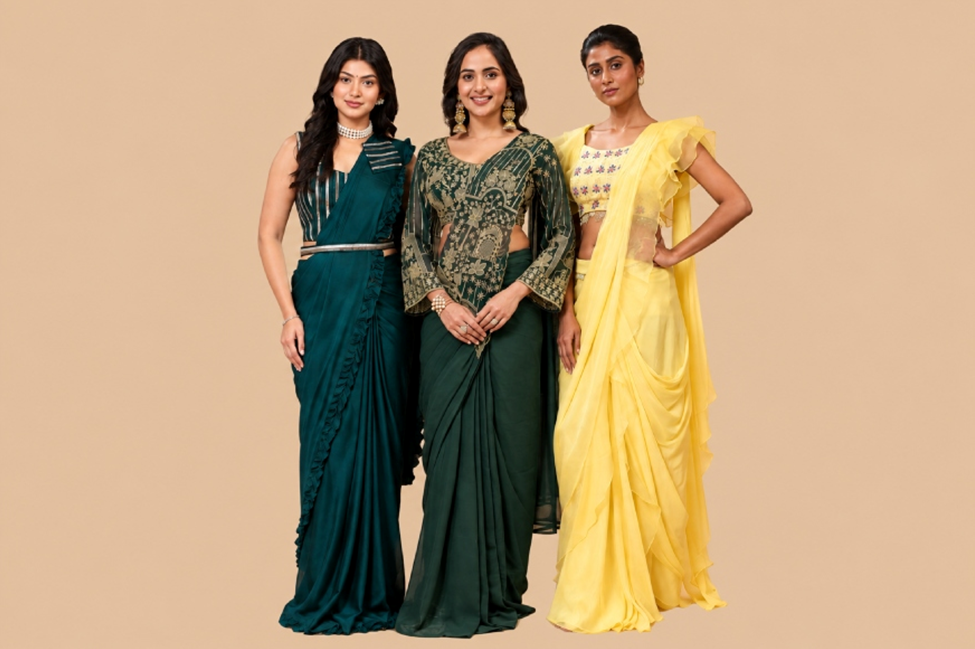
Most Indian women own at least one saree they love but hardly ever wear. It stays folded in the cupboard, waiting for an occasion worth the forty-five minutes it takes to drape. The pleats have to be measured by hand, the pallu pinned, and if the length comes out wrong you start over. This is where ready to wear sarees come into the picture.
A ready to wear saree, also called a pre-stitched or readymade saree, is a very easy garment to work with. The pleats are already stitched onto a fitted skirt. The pallu is set. You step into it like a dress, fasten the zip at the waist, and that’s really all there is to it. Some styles take two minutes. Most take less.
So, if you’re thinking about buying one, let’s understand how readymade sarees are changing the way Indian women dress for celebrations.
Easy to Wear, Even for First-Time Saree Wearers
Draping used to be something you picked up from your mother, or from whichever aunt was good at it. Miss those lessons, and you probably reached for a lehenga instead.
Read More: Sometimes Love Needs No Occasion: Why a 14 Karat Gold Necklace is the Perfect Gift?
Pre-stitched sarees have changed that. College students wear them. Working women wear them to office functions. NRI women who have nobody nearby to help with the pleats wear them most of all. The skill is simply not required anymore.
Comfortable and Secure Through Long Celebration Days
Indian functions are long. A wedding day can begin at seven in the morning and finish past midnight. Navratri nights go on for hours. A hand-drape does not really survive all that. The pleats slip, the pallu works loose, and you end up in front of a mirror every half hour fixing it.
A readymade saree holds. The pleats stay where they were stitched, and the pallu stays put, so you can dance and eat without thinking about it. In wedding season, that counts for a lot.
The Perfect Blend of Designer Craftsmanship and Convenience
There was a time when a pre-stitched saree meant settling for something plain. Not anymore. Designer sarees in this format come in the same fabrics as traditional Indian sarees. Here’s what you’ll usually find:
- Georgette, which is light and fluid and holds stitched pleats very well.
- Satin, smooth and glossy, and a good pick for receptions and evening functions.
- Organza, which is crisp and sheer and gives the drape structure and volume.
- Silk blends for weddings, temple visits and the more traditional ceremonies.
The work on them is just as good. Sequins for parties, embroidery for festive wear, prints for regular days, heavier embellishments for weddings.
Travel-Friendly and Practical for Life Abroad
A ready to wear saree isn’t only convenient at home; it’s also a sensible thing to pack when you’re travelling. This is because:
- It folds down small and doesn’t need a long session with the iron.
- You won’t be hunting for a tailor or a helpful aunty in a city where you know nobody.
- The drape looks the same in Mumbai, in London and in New Jersey.
- Pair it with a readymade blouse, and the outfit comes out of the suitcase ready.
A Fresh Wave of Designs and Styling Options
The most interesting part is what designers have done with it. Once the drape stopped being fixed by hand, the shape opened up. Ruffled hems. Lehenga-style flares. Belted waists, saree gowns, cape pallus. Some of these would be very hard to hold in place by hand.
Read More: Best Sunscreen for Face & Sunscreen for Dry Skin: Complete Protection Guide
Styling has more room too. A corset blouse gives you a defined waist. A jacket blouse pushes the look towards fusion. A belt over the pallu changes the silhouette. Add temple jewellery if you want it traditional. Or keep it light and let the saree do the work.
When it comes to modern ethnic wear, the ready to wear saree is an all-rounder that almost any woman can wear and style. It hasn’t replaced the classic drape and it isn’t trying to. It has simply made the saree easier to own, and a lot easier to wear.